
AI App Development in 2026: How AI Is Changing Mobile Apps?


AI app development has completely changed what it means to build a mobile app in 2026.
What used to take a team of mobile app developers six to nine months can now ship in half that time with smarter features, lower costs, and apps that literally learn from their users. And no, this isn't hype. It's already happening inside every serious mobile app development company right now.
I've spent over a decade watching development trends come and go.
Some fizzled out (remember when everything had to be a chatbot in 2017?). This one is different. AI isn't just another feature you bolt onto an app anymore it's changing the entire way apps get planned, coded, tested, and shipped.
So let's break down exactly what's changed, what it costs, and what it means if you're planning to build an app with top AI app development company like Techspiration this year.
What Is AI App Development?

AI app development is the process of building mobile applications that use artificial intelligence like machine learning, natural language processing, and generative AI to deliver smart, personalized, and automated experiences. It also refers to using AI tools to write, test, and ship the app itself faster.
Notice the two sides there? That's the part most people miss.
When someone says "AI in mobile apps," they usually think of AI inside the app, a chatbot, a recommendation engine, a photo filter.
But in 2026, the bigger shift is AI building the app. Tools like GitHub Copilot, Cursor, and Claude are now writing a huge share of production code, and the best mobile app developers have essentially become editors and architects rather than line-by-line coders.
Both sides matter. And both are reshaping budgets, timelines, and what users expect from every app on their phone.
How Is AI Changing Mobile App Development in 2026?

AI is changing mobile app development in five major ways: AI-assisted coding, automated testing, hyper-personalization, on-device AI, and AI agents inside apps. Together, these cut development time by 30–50% and make apps smarter after launch, not just at launch.
Let's look at each one because if you're hiring a mobile app development company this year, these are the things you should be asking about.
1. AI-Assisted Coding
Here's a stat that would've sounded insane three years ago: at many development firms, AI coding assistants now generate 40–60% of first-draft code. Developers review it, refine it, and handle the hard architectural decisions.
What does that mean for you?
Faster builds and fewer billable hours on boilerplate work. A mid-complexity app that took 1,200 development hours in 2023 might take 700–800 today. Good AI app development services pass a chunk of those savings on to clients.
2. Automated Testing and Bug Detection
QA used to be the slowest, most painful phase of mobile app development. Now, AI-powered testing tools generate test cases automatically, simulate thousands of user paths, and flag bugs before a human tester ever opens the app.
The result?
Fewer post-launch crashes and app store reviews that don't start with "this app keeps freezing."
Also Read - How to Build a Mobile App in India?
3. Hyper-Personalization That Actually Works
Netflix-style personalization used to be an enterprise luxury. In 2026, it's table stakes. Modern apps use machine learning to adapt layouts, content, notifications, and offers to each individual user in real time.
Apps with AI-driven personalization consistently see 20–30% higher retention and retention, not downloads, is what makes an app profitable.
4. On-Device AI
Thanks to chips like Apple's Neural Engine and Google's Tensor, AI now runs directly on the phone. That means instant responses, no server costs for every request, and better privacy since data never leaves the device.
For healthcare and fintech apps especially, on-device AI is becoming the default answer to compliance headaches.
5. AI Agents Inside Apps
This is the big one for 2026. Apps are moving from "tap and scroll" to "just tell it what you want." AI agents inside apps can now book the appointment, reorder the groceries, or dispute the transaction for you, not just show you a screen where you do it yourself.
If you're planning an app right now, this is the feature gap your competitors will exploit if you don't.
What Does Generative AI Development Mean for Mobile Apps?

Generative AI development means building apps that can create content, text, images, voice, code, or designs on demand. In mobile apps, it powers features like AI writing assistants, image generators, voice agents, and conversational search.
Think of the apps winning right now: photo editors that regenerate backgrounds, fitness apps that write custom workout plans, shopping apps where you describe what you want instead of filtering through menus. That's generative AI development in action.
And here's the practical bit: you don't need to train your own model. Most teams build on top of existing models (GPT, Gemini, Claude, Llama) through APIs, which keeps generative AI features surprisingly affordable, often $15,000–$40,000 to add to an existing app, depending on complexity.
How Much Does AI App Development Cost in 2026?
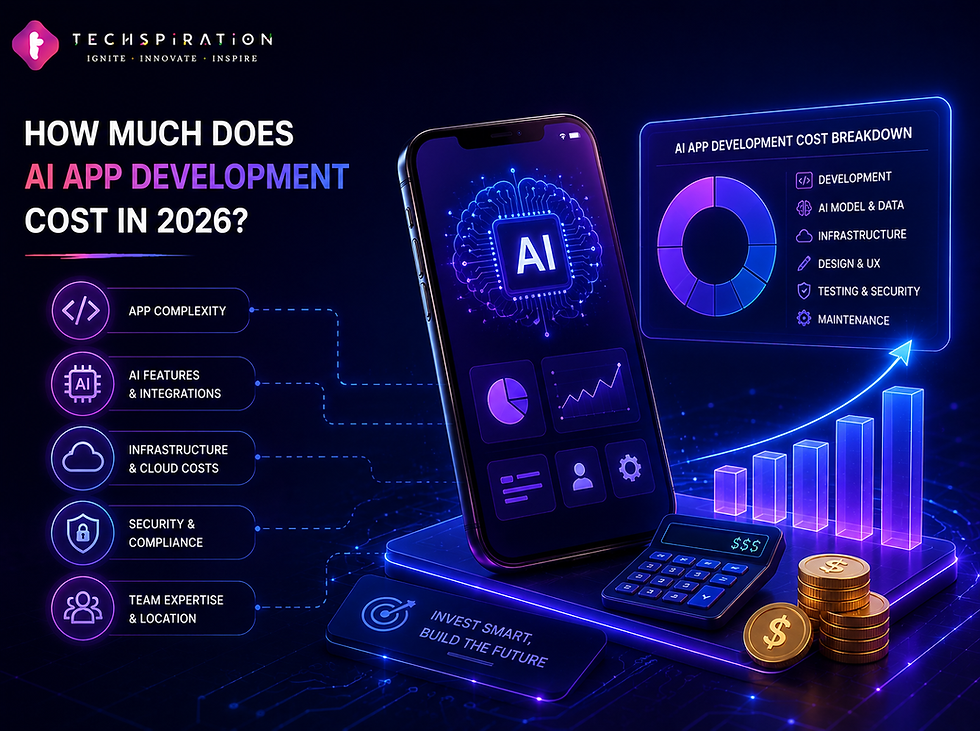
AI app development costs between $30,000 and $300,000+ in 2026, depending on complexity. A simple app with basic AI features starts around $30,000–$60,000, mid-level apps run $60,000–$150,000, and enterprise-grade AI apps exceed $150,000.
Here's a quick breakdown:
App Complexity | Typical Features | Estimated Cost (USD) | Timeline |
Basic AI app | Chatbot, simple recommendations | $30K–$60K | 2–4 months |
Mid-level AI app | Personalization, generative AI features, analytics | $60K–$150K | 4–7 months |
Enterprise AI app | Custom ML models, AI agents, integrations | $150K–$300K+ | 7–12 months |
One more thing worth knowing: rates vary massively by region. Hiring an AI app development company in India typically costs $25–$60 per hour, compared to $120–$250 per hour in the US or UK, with quality that's now genuinely comparable at the top firms.
That's why so many American and British startups run hybrid teams: strategy in-house, development offshore.
Should You Hire an AI App Development Company or Build In-House?
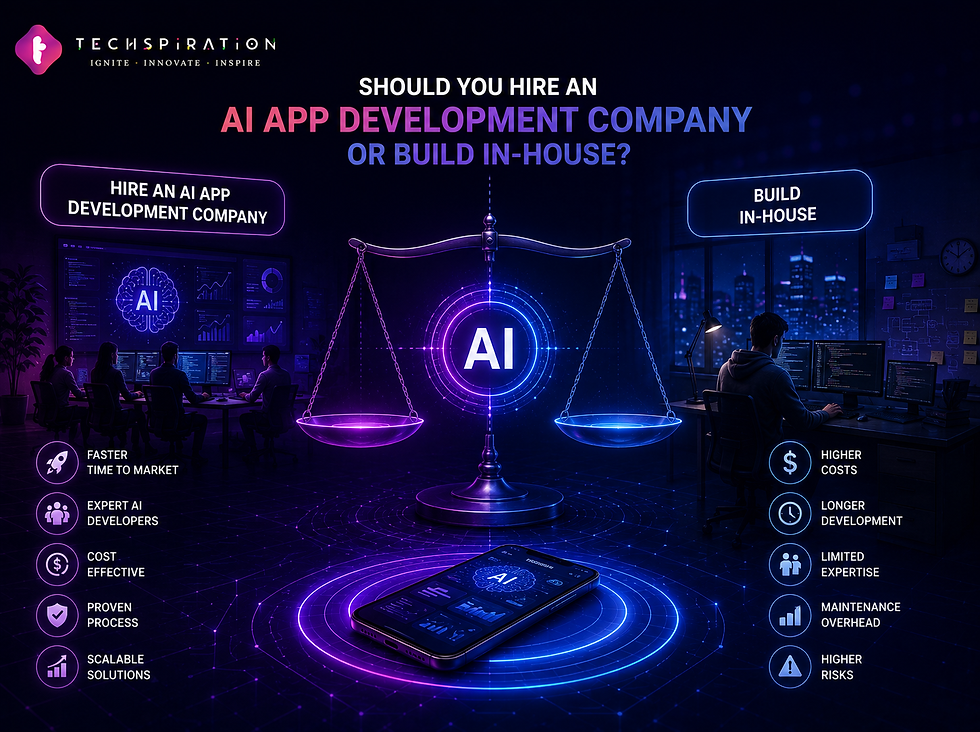
Honest answer? For most businesses, partnering wins.
Building an in-house AI team means recruiting ML engineers (scarce and expensive), mobile app developers, data engineers, and DevOps easily $500K+ per year in salaries before you've shipped anything. A specialized partner offering AI app development services gives you that entire team on day one, with battle-tested processes.
When you're evaluating a mobile app development company, ask these three questions:
"Show me a live AI feature you've shipped, not a demo." Demos are easy. Production AI with real users is hard.
"How do you handle AI costs after launch?" API calls, model updates, and monitoring are ongoing costs. Good partners plan for them upfront.
"What's your approach to data privacy?" Especially critical if you're in healthcare, finance, or handling EU/UK user data.
If a company can't answer all three confidently, keep looking.
What's Next: Where AI App Development Is Headed?
Quick preview of what's coming over the next 12–18 months, because it should influence what you build today:
Agent-first apps interfaces where you talk or type your goal, and the app just does it
Small language models (SLMs) running fully on-device for speed and privacy
Self-improving apps that A/B test and optimize their own features using AI
AI-generated UI that adapts layouts per user, per session
The takeaway?
Build your app with an AI roadmap, even if version one is simple. Retrofitting AI into an app that wasn't designed for it costs 2–3x more.
FAQs
1. Is AI app development more expensive than traditional mobile app development?
Upfront, slightly usually 15-30% more due to AI expertise and integration work. But total cost of ownership is often lower, because AI-assisted coding reduces development hours and automated testing cuts QA costs. Plus, AI features drive higher retention, which improves ROI.
2. How long does it take to build an AI-powered mobile app?
A basic AI app takes 2-4 months, while complex apps with custom models take 7-12 months. AI-assisted development has shortened these timelines by 30–50% compared to 2023.
3. Will AI replace mobile app developers?
No, but it's changing what they do. AI handles repetitive coding while developers focus on architecture, problem-solving, and product decisions.
Companies still need skilled mobile app developers; they just need them working differently.
4. Why do businesses choose an AI app development company in India?
Cost and talent depth. India offers rates of $25–$60/hour versus $120-$250/hour in the US/UK, one of the world's largest AI engineering talent pools, and time-zone coverage that enables round-the-clock development.
5. Can I add AI features to my existing app?
Yes. Most generative AI development work today is exactly this: integrating AI chatbots, personalization, or voice features into existing apps via APIs, typically for $15K–$40K.
Ready to build something smarter?
Whether you're starting from scratch or upgrading an existing product, the right partner makes all the difference. Talk to our team about your idea, we'll tell you honestly what AI can (and can't) do for your app, and what it'll actually cost.


Comments